Every ad on the platform rendered through a single fixed template per ad slot. One layout, every context — cropping, padding, and stretching real ad content to fit a mold that couldn't adapt to them.
The problem
A fixed template can't bend to the variety of real ad content. Images were cropped and padded to fit predetermined sizes; layouts came out blurry, inconsistent, and visibly off-native — they didn't match the editorial style of the surrounding content. Two things were at stake at once.
Experience: ads looked broken inside an otherwise polished content feed, eroding the trust that keeps people reading. Business: one template for everyone left real monetization and personalization on the table — the same ad, shown identically, in every context, to every reader.
The bet behind Dynamic Template Selection (DTS): host many templates and serve the most suitable one based on signals — reader context, content partner, ad assets — instead of forcing every ad through one shape.
surface
My role
Dynamic Template Selection (DTS) was a complex, multi-year effort spanning many components and several designers. I owned the design for DTS on existing content feeds and article pages — brought in because I'd already been working in the space.
You've done a lot of work in this space already — take on Dynamic Template Selection work for existing content feeds and article pages that you've started.
Product leadership, on assigning ownership
Concretely, I drove the in-article and native-to-display-style templates, the dynamic title system, gallery and infopane iterations, and the responsive image-sizing rules — working across Product, the content team, and machine learning / platform engineering.
The hard part: native coherence vs. monetization
The central tension wasn't visual — it was philosophical. More expressive, "display-style" templates (traditional banner-ad appearance) monetize better, but they risk breaking the reading experience of a native-style feed (where ads match editorial content). I explored the aggressive end of that spectrum — enriched backgrounds, AI-extended imagery, custom fonts and call-to-action buttons, multi-image layouts — and ran straight into the content team's core concern:
Some of these explorations might break coherence.
Content team review
That tension became the design problem. Not "how do I make a prettier ad card," but: how expressive can an ad get before it stops feeling like part of the page — and where, exactly, is that line?
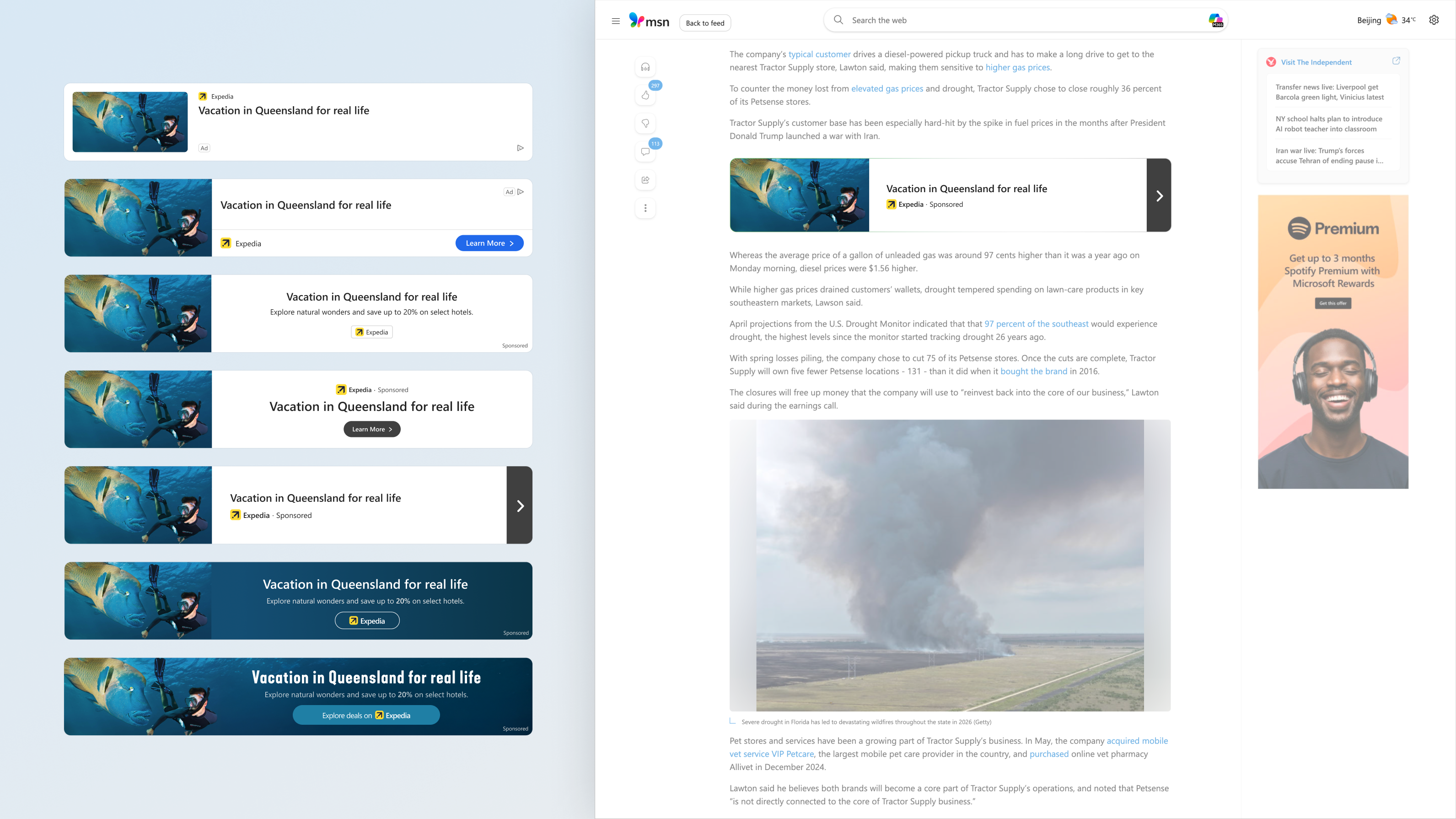
The shift that mattered: from mocks to a rule system
Designing this as individual mockups didn't scale. Every asset combination, every missing optional asset, every aspect ratio was a new edge case. The turning point was moving from drawing screens to specifying a system.
The document that specifies all the rules, constraints, and scenarios for each template would be important for implementation.
Design review discussion
I co-authored the framework defining the rules, constraints, and fallback scenarios for each template — including how a layout must still hold up when the backend returns none of its optional assets. That's the shift from designer-as-screen-maker to designer-as-system-author.
Validating with experiments — including one that failed
We adopted an experiment-first philosophy: ship it behind a controlled test, let performance decide. Where it worked, it worked measurably.
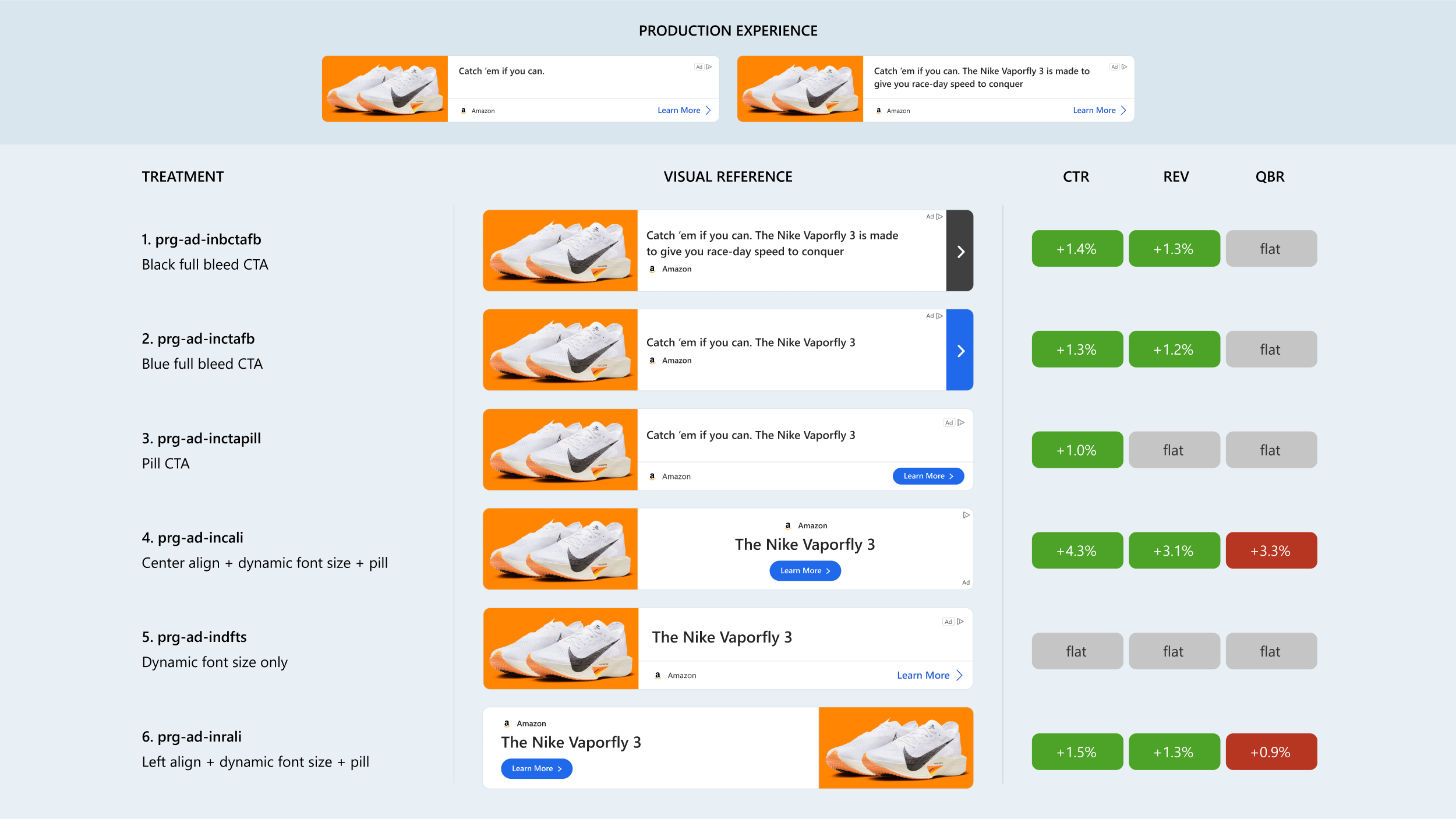
A more display-style multi-template experiment went negative on CTR. I diagnosed the cause: the new templates looked less native (didn't match editorial content), creating a broken reading experience. We killed it. The exact coherence risk the content team raised at the start showed up in the data — and our experiment-first approach meant we caught it before it shipped to everyone. The line between "expressive" and "broken" wasn't a matter of taste. We found it empirically.
Outcome
DTS infrastructure shipped across all supported ad types and content partners — replacing single-template rendering with a model-driven framework. Beyond the metrics, the lasting output was a reusable template rule-system: a way for the platform to keep adding ad experiences without re-litigating coherence-versus-revenue from scratch every time.
The senior lesson underneath it: at platform scale, the deliverable isn't the screen — it's the system of rules that generates good screens under conditions you'll never fully see in advance.