Most advertising platforms personalize by targeting users. But what if ads themselves could adapt — changing format, content, and presentation based on who's viewing, what they're reading, and what creative assets are available? That's the question behind the personalization framework I designed for consumer advertising in news feeds and content surfaces in H1 2024.
The problem: personalization stops at targeting
Traditional ad personalization asks: "Which ad should we show this user?" The system picks from a fixed set of ads based on user profile, then displays the winner. The ad itself never changes — same creative, same format, same message.
But that model breaks down in modern content experiences like news feeds and story streams, where:
- Users aren't always signed in (no persistent profile)
- Context matters more than history (reading about travel vs. finance changes relevance)
- Ad creative has rich assets that could adapt (multiple images, headlines, CTAs)
- Placement varies dramatically (in-stream vs. sidebar vs. response card)
The real opportunity wasn't just which ad to show — it was how the ad itself should adapt to make the experience feel native, relevant, and contextually intelligent.
The framework: three layers of intelligent adaptation
I designed a personalization system built on three independent but composable layers. Instead of requiring all signals to be present, the system adapts based on what it knows — making ads smarter even when user data is limited.
Layer 1: User Awareness
When we know about the user — their profile, interests, preferences, past behavior — ads can adapt to match personal relevance. This layer handles traditional personalization signals but gracefully degrades when users aren't signed in or haven't built a preference history.
- Profile signals (demographics, location, language)
- Preference signals (product interests, brand affinity, price sensitivity)
- Behavioral signals (browsing patterns, past engagement)
Layer 2: Context Awareness
Even without knowing the user, we know the context: what content they're reading, what query brought them here, where the ad appears on the page. Ads should adapt to feel native to that context — a travel ad in a travel article should look different than the same ad in a finance article.
- Content context (article topic, sentiment, reading depth)
- Query context (search intent, information-seeking vs. transactional)
- Placement context (in-stream vs. sidebar, card vs. banner)
Layer 3: Ad Awareness
Every ad has multiple creative assets — images, headlines, descriptions, CTAs. Instead of showing the same fixed creative every time, the system should adapt the ad itself based on available space, context, and what's likely to resonate. This layer makes ads feel tailored even when we don't know the user at all.
- Creative asset selection (which image, which headline)
- Format adaptation (card vs. banner vs. native unit)
- Rendering optimization (layout, typography, visual hierarchy)
The key insight: these layers compose. If we only have context (Layer 2) and creative assets (Layer 3), we can still deliver a better experience than a static ad. If we have all three layers, the experience becomes deeply personalized.
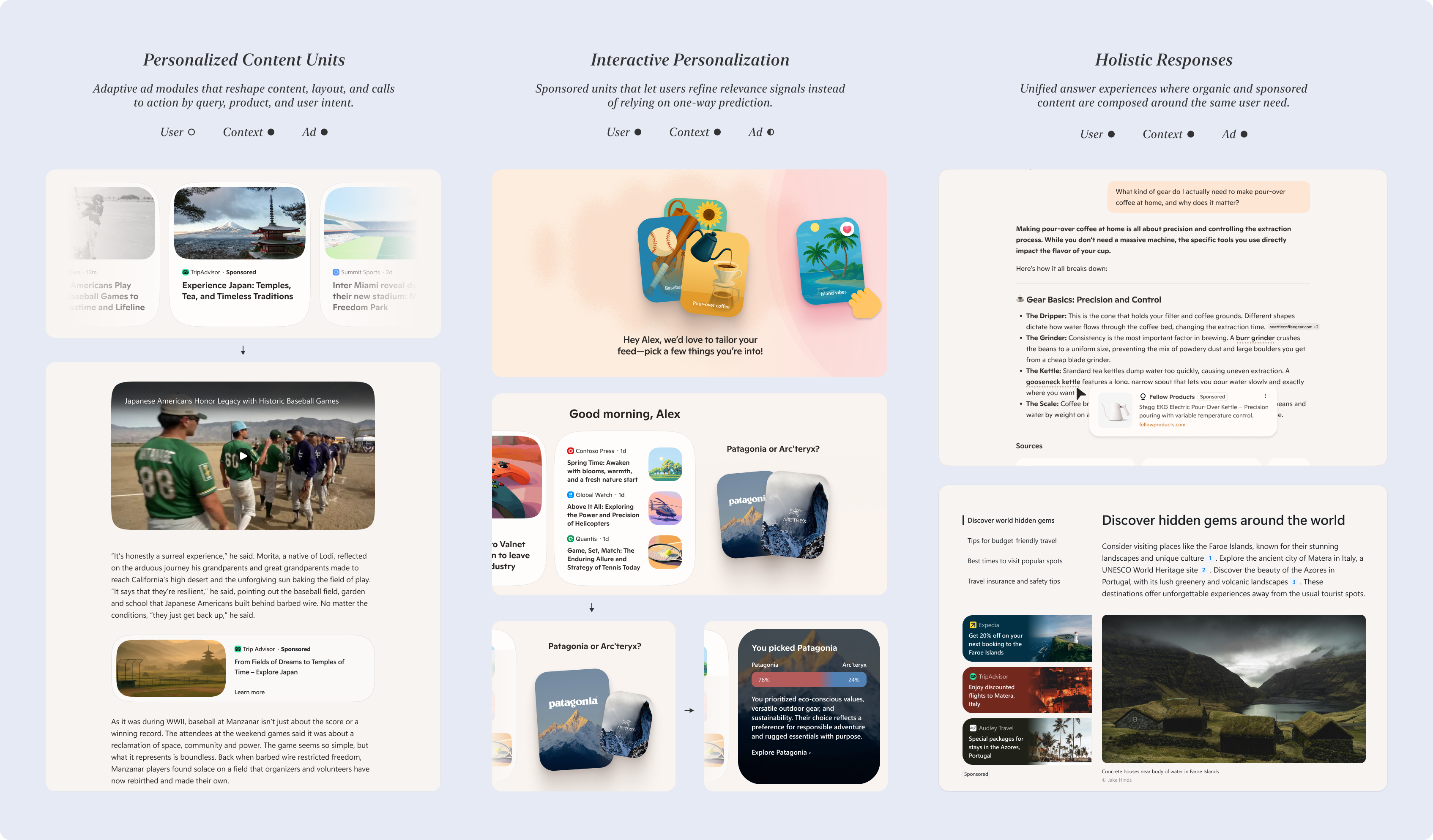
Strategic concepts: "Contextual Assets Optimization"
Beyond the core framework, I designed several forward-looking concepts that explored how intelligent ad personalization could transform the consumer experience. I created a new strategic category called "Contextual Assets Optimization" to describe this opportunity space.
Personalized Content Units
Ad experiences that adapt their entire presentation based on query context, product category, and user preferences. Examples included dynamic "showroom" experiences and adaptive filters that change based on what matters most in that context (price for budget searches, features for comparison searches, availability for immediate-need queries).
Interactive Personalization
Rather than showing a static ad, users could refine relevance through lightweight interaction. Sponsored content units with opportunities to refresh offers, signal preferences, and better align results with interests — making personalization a two-way conversation instead of a one-way guess.
Holistic Responses
Blending organic content and sponsored content into unified answer experiences, where the personalization framework ensures ads feel like helpful recommendations rather than interruptions. The same three layers (user, context, ad) determine not just what to show but how to integrate it naturally.
Impact and influence: from exploration to strategy
This was north star exploration work — not a shipped feature with metrics, but strategic design thinking that influenced how the organization approaches ad personalization. The framework I designed became a reference point for future monetization strategy.
What I delivered
- Three-layer personalization framework — The conceptual model for how user, context, and ad signals compose to create adaptive experiences
- "Contextual Assets Optimization" as a strategic category — Defined a new opportunity space for intelligent ad adaptation
- Consumer ad personalization explorations — Figma prototypes and concepts for personalized ad experiences in news feeds and content surfaces
- Strategic concept presentations — Personalized content units, interactive personalization, holistic responses
- Innovation opportunities framework — Contributed to leadership review materials defining future monetization direction
Presented to and validated by
The work was presented to Gary Anderson (Head of Ad Design), Vincent Muedra, and the global design team, with concepts prepared for leadership review. Gary Anderson explicitly recognized the personalization framework as the strategic direction he was looking for, and the work was consolidated into broader monetization innovation planning.
The exploration influenced ongoing personalization strategy discussions and became a reference for how AI capabilities could transform consumer ad experiences in news feeds and Microsoft content surfaces.
Why this matters: designing for intelligence, not just interaction
Most ad design work focuses on how ads look (visual design) or how users interact with them (UX design). This work operates at a different altitude: how ads should think — the logic that makes them contextually intelligent.
That's the hardest design problem in advertising: not "what button goes where" but "what signals should the system consider, how should they combine, and how should the ad adapt as a result?" It's system design, not surface design.
This work also completes a narrative arc across my AI-related projects:
- DTS (Case 1) — AI optimizes ad templates by selecting the best layout
- Banner Generation (Case 2) — AI learns design rules to create adaptive layouts
- Ad Personalization (Case 3) — AI makes ads contextually intelligent by composing signals
Each case shows AI at a different layer: optimization → creation → intelligence. The progression demonstrates how I think about AI not just as a tool for automation, but as a system that should understand context and make experiences feel adaptive rather than algorithmic.
This case study describes strategic exploration and framework design, not a launched product. The value is in demonstrating how I approach complex, unsolved problems and design system logic that could guide future implementation. The framework influenced monetization strategy, but I'm not claiming shipped metrics or direct product outcomes.